ISLANDS: Integrated Scottish Liver And metabolic Disease Study. Building a National Platform for MASLD Research, Biomarker Discovery and Trial Readiness in Scotland
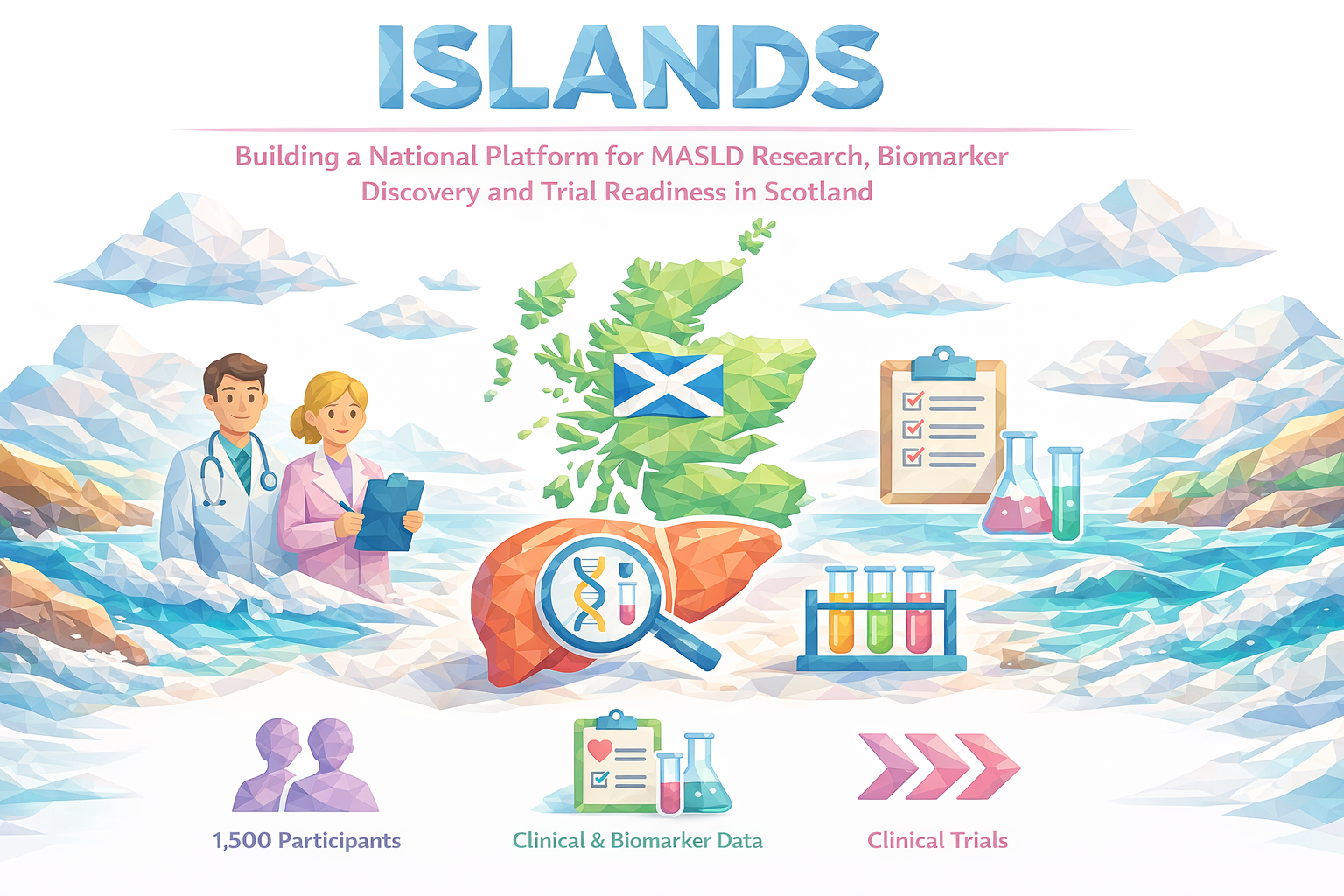
ISLANDS: Building a National Platform for MASLD Research, Biomarker Discovery and Trial Readiness in Scotland
Metabolic dysfunction-associated steatotic liver disease, or MASLD, is now one of the biggest unmet needs in modern medicine. It is common, progressive, frequently underdiagnosed and increasingly central to global drug development. Yet despite the pace of scientific and commercial interest in this area, one of the major barriers to progress remains the same: the lack of scalable, deeply characterised, trial-ready patient cohorts linked to meaningful longitudinal data and high-quality biological samples.
That is the problem ISLANDS has been designed to address.
ISLANDS – the Integrated Scottish Liver And metabolic Disease Study – is a proposed national research platform being led by BDD in collaboration with leading NHS hepatology and gastroenterology clinicians and Professor Jonathan Fallowfield at the University of Edinburgh. Its aim is to create a prospective Scotland-wide MASLD registry and biobank capable of supporting biomarker discovery, risk stratification, translational research and faster recruitment into interventional clinical studies. The project is intended to recruit 1,500 participants over five years, with annual follow-up and linked clinical, phenotypic and biosample data.
Why MASLD needs a new research infrastructure
MASLD is the most common cause of chronic liver disease worldwide and affects a substantial proportion of the adult population. The challenge is not simply prevalence. It is the disconnect between scale and visibility. Many people live with MASLD for years without diagnosis, and by the time the disease is recognised, some are already on a pathway toward advanced fibrosis, cirrhosis, liver cancer and other serious complications. The burden is clinical, economic and societal. In Scotland in particular, liver disease has been framed as a public health emergency, with strong links to health inequality and deprivation.
At the same time, the therapeutic and diagnostic landscape is moving quickly. Pharmaceutical and biotech companies are investing heavily in metabolic liver disease, while researchers and diagnostics developers are searching for better ways to identify those at greatest risk of progression, response or poor outcomes. But progress in this space depends on access to the right patients, the right data and the right infrastructure. Without that, biomarker work is slower, recruitment is harder, studies become more expensive, and commercial timelines stretch.
ISLANDS has been conceived as a practical answer to that bottleneck: a structured, prospective, participant-consented platform that can serve science, patients and commercial development at the same time.
What ISLANDS is designed to do
At its core, ISLANDS is not just a registry and not just a biobank. It is intended to be a research engine.
The platform is designed to identify and enrol individuals with MASLD, capture rich baseline and longitudinal clinical information, and link those data to plasma and serum samples collected under appropriate governance and participant consent. Participants would be followed annually for a minimum of five years, creating a dataset with the kind of depth and continuity that is often missing in emerging therapeutic areas.
The project’s stated objectives go well beyond data collection alone. ISLANDS is intended to help identify individuals at highest risk, create a consented database for future commercial and academic interventional research, support validation of biomarkers and other prognostic factors, provide a well-phenotyped real-world dataset that could inform future trials, and create the foundations for AI-enabled risk prediction and clinical decision-support tools. It also includes the establishment of a biobank that can support precision medicine approaches by linking samples with longitudinal phenotype data.
In other words, the ambition is to build a national platform that can answer scientific questions today while becoming increasingly valuable as new therapies, diagnostics and data tools enter the market.
A platform built for translational and commercial relevance
One of the strongest aspects of ISLANDS is that it has been designed from the outset with real-world translational value in mind.
Too many clinical datasets are academically interesting but operationally difficult to use. Too many biobanks hold valuable samples but lack the phenotypic depth, governance structure or participant consent needed to unlock broader commercial use. Too many recruitment pathways remain fragmented, forcing sponsors to build feasibility from scratch. ISLANDS is intended to overcome those limitations by combining prospective data capture, sample banking, governance, commercial access planning and a clear route to study recruitment in one platform.
For industry, that matters.
A deeply characterised MASLD cohort has value at multiple points in the development cycle. It can support biomarker discovery and validation. It can improve cohort identification and feasibility modelling. It can shorten timelines to patient recruitment. It can help sponsors and CROs access patients suitable for Phase I and downstream interventional work. It can provide access to linked biospecimens and anonymised clinical data under a structured access model. And over time, it can generate a growing body of longitudinal evidence relevant to disease progression, stratification and trial design.
The application is explicit that one of the biggest challenges in clinical trials is recruitment, and that a well-characterised MASLD database could help attract global studies into Glasgow and Scotland. It also sets out a commercialisation pathway based on cohort access and feasibility services, biobank and data access, and Phase I MASLD studies delivered through BDD.
Why BDD is leading this project
BDD’s role in ISLANDS is not incidental. It is central to why the project is credible.
BDD brings more than 25 years of clinical research experience in Scotland, established infrastructure, regulatory capability, participant recruitment expertise, and a commercial mindset shaped by long-term work with international sponsors. In the application, BDD is positioned as the day-to-day commercial lead responsible for project delivery, governance support, industry engagement and eventual commercialisation of both the patient database and associated biobanked samples.
That commercial strength is matched by deep clinical leadership. BDD’s Research Medical Director, Dr Lyn Corry, is an experienced clinical researcher and former Consultant Gastroenterologist, bringing extensive expertise in gastroenterology, study design and delivery. Together, this gives ISLANDS both the operational capability and the clinical insight needed to build a research platform that is credible to sponsors, investigators and patients alike.
That matters because building a national asset is one challenge; turning it into something useful, accessible and sustainable is another.
ISLANDS is designed to sit at the intersection of industry, academia and the NHS. BDD’s experience operating in a regulated clinical research environment, coupled with existing sponsor and CRO relationships, gives the project a route not just to set-up, but to actual utilisation. The commercial model includes marketing via BDD’s existing channels and business development activity, alongside industry outreach and structured access arrangements.
This is exactly where BDD can add value: not only as a delivery partner, but as the organisation capable of translating a national research platform into a practical resource for sponsors, biotech companies, diagnostics developers and CROs.
A true partnership model across industry, academia and the NHS
ISLANDS is also notable for the strength of the partnership around it.
Professor Jonathan Fallowfield, Chair of Translational Liver Research at the University of Edinburgh, as academic lead, with NHS clinical leadership provided through consultants based within NHS Greater Glasgow and Clyde. This will facilitate expanded reach further through participant identification centres across a network of participant identification centre (PIC) sites across Scotland’s territorial NHS health boards will give ISLANDS genuine national reach, moving it beyond a single-site study to a truly Scotland-wide research platform.
That structure is important for two reasons.
First, it gives the project scientific and clinical credibility. A platform like this only has value if the data, disease characterisation, recruitment pathways and outputs are robust. The involvement of academic and NHS experts strengthens that foundation.
Second, it makes the platform more relevant to external partners. Sponsors are not just looking for data; they are looking for confidence in governance, in participant pathways, in translational depth, and in the ability to operationalise collaborations effectively. ISLANDS has been conceived with those expectations in mind, including a steering and governance structure, defined access processes, QA oversight and secure IT systems for both database and biobanking functions.
What industry partners stand to gain
For pharmaceutical, biotech, CRO and diagnostics partners, the opportunity is straightforward.
A high-quality, prospective MASLD platform in Scotland could reduce the friction that currently slows research in this area. Instead of approaching the field through fragmented sites, incomplete datasets or narrow retrospective sources, partners could engage with a single coordinated infrastructure designed to support feasibility, biomarker research, cohort identification and future interventional studies.
For therapeutic developers, that could mean faster identification of relevant participants, better understanding of disease stage and progression, and a more efficient route into Phase I or later-stage programmes. For diagnostics and biomarker companies, it creates the possibility of working with linked biospecimens and phenotypic datasets that are specifically intended to support translational research. For CROs, it offers a differentiated route into a growing therapeutic area with increasing commercial demand.
It also makes the broader market case clearly. It identifies a rising global pipeline in MASLD/MASH, a substantial volume of Phase I activity, and an addressable market for commercial early-phase work. ISLANDS is positioned not simply as a public-good registry, but as infrastructure capable of attracting inward investment, follow-on studies and long-term commercial partnerships.
That is the crux of the sponsorship proposition: support the creation of the platform, and gain early alignment with one of the most strategically useful MASLD research assets being built in the UK.
Beyond recruitment: Creating a durable national asset
The long-term significance of ISLANDS is that it is designed to become more valuable over time.
In year one, the emphasis is on infrastructure, governance, approvals and initial recruitment. By year two and beyond it moves into scale-up, early analytics, commercial engagement and initial industry-sponsored activity. By year five, the ambition is for recruitment to be complete and for the platform to transition toward long-term financial sustainability through multiple income streams, including cohort access, biospecimen and data services, and MASLD-focused clinical research.
That long-view matters. Sponsors are far more likely to engage with infrastructure that is intended to persist, mature and generate downstream value than with a short-lived or purely exploratory project. ISLANDS has been framed from the outset as a national data and biosample asset that can support repeated use, multiple collaboration types and future expansion.
It is also designed to support broader scientific outputs, including peer-reviewed publications and publicly accessible reporting, helping to build visibility and credibility while also acting as an indirect engine for further engagement from multinational pharma and CRO companies.
Why this matters for Scotland – and why it matters now
There is also a wider strategic importance to this project.
Scotland has the clinical expertise, the academic base and the patient need to be highly relevant in MASLD research. What it has lacked is a single coordinated platform capable of translating those strengths into a nationally visible, commercially meaningful proposition. ISLANDS aims to fill that gap. This explicitly positions the project as a way to strengthen the Scottish life sciences cluster, attract investment, support high-value employment, and improve the country’s competitiveness in commercial clinical research.
Timing matters here. MASLD is no longer a fringe indication. It is a major therapeutic and translational focus. Companies are moving now. Diagnostic strategies are evolving now. Biomarker questions are active now. Recruitment competition is real now. If Scotland is going to secure a stronger position in this field, the infrastructure needs to be built before the opportunity passes to better-prepared regions. That urgency is reflected throughout the application.
The vision
The vision for ISLANDS is ambitious but practical: a Scotland-wide MASLD registry and biobank that helps identify high-risk individuals earlier, supports biomarker and translational research, accelerates recruitment into studies, attracts global industry engagement, and becomes a sustainable national platform for liver disease innovation.
For patients, that means better visibility, greater access to research and, ultimately, a better chance that innovation reaches the clinic faster.
For researchers and clinicians, it means access to an infrastructure that is built for long-term use rather than one-off studies.
For sponsors and commercial partners, it means access to a strategically relevant platform designed to reduce barriers, improve readiness and create a smarter route into one of the most active areas of metabolic disease research.
That is why ISLANDS matters.
And that is why BDD is committed to helping build it.
Interested in partnering with ISLANDS?
BDD is actively engaging with pharmaceutical, biotech, CRO and diagnostics organisations interested in supporting or collaborating with this initiative. To discuss sponsorship, research access or strategic partnership opportunities, please get in touch.